
Inside any data center, space means everything. As a result, your server rack sizes are a critical piece of ensuring proper airflow, energy consumption, and overall scalability. But with so many different unit measurements, from 18U to towering 60U frames, how should you decide where to start?
In this guide, we’ll break down everything you need to know about servers in a data center, including the standard unit measurements and how to strategically choose the right size for your business.
What Are Data Center Server Racks?
Before we discuss the normal server rack sizes, let’s quickly establish what a server rack is. At their core, server racks are metal frameworks designed to hold and organize advanced equipment, including servers, switches, routers, and other hardware essential to digital infrastructure. They’re the backbone of modern data centers, keeping equipment secure, organized, and accessible for maintenance or upgrades.
- Floor Space: The wrong server rack size can lead to wasted space or overcrowding.
- Airflow and Cooling: Proper rack sizing ensures optimal heat dissipation and prevents equipment failures.
- Cable Management: More rack space allows for clean, organized cable runs, essential for uptime and troubleshooting.
- Scalability: Choosing the right height and standard server rack depth now gives you room to grow later without a full data center redesign.
So, what measurements do you most commonly see? Most servers in a data center follow standard width formats, such as 19″, 23″, or 24″, but the height (measured in Rack Units) is where customization is crucial.
Now, the data center racks you ultimately craft will be used for more than simply storing equipment. Their size and design directly impact critical aspects of data center operations, including:
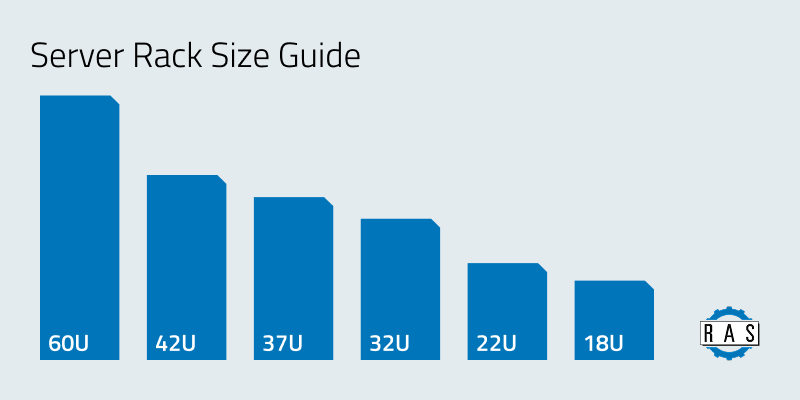
Whether you’re crafting a normal server rack size or building equipment that’s more custom to your data center, the importance of size is key to delivering smarter, scalable infrastructure
Understanding Rack Units (U) and Standard Server Rack Sizes
We all know that server racks are more than just pieces of metal. As a result, their dimensions play a critical role in overall performance. At the heart of this is the Rack Unit (U), which represents the universal language of server rack sizes.
A rack unit (often written as RU or just U) is a measure of vertical space. A single unit, or 1U, is the equivalent of 1.75 inches in height. For example, if the servers in your data center are 42U, they’ll boast 73.5 inches of usable vertical space.
Servers and equipment are designed to align with these measurements, so if you need a 2U server, you’ll go for two units and so on.
Now, when it comes to dimensions, most server racks share a common width, but this can change depending on your needs. Typically, width is:
- 19 inches for most.
- 23-24 inches for certain telecom data centers or other specialized pieces of equipment.
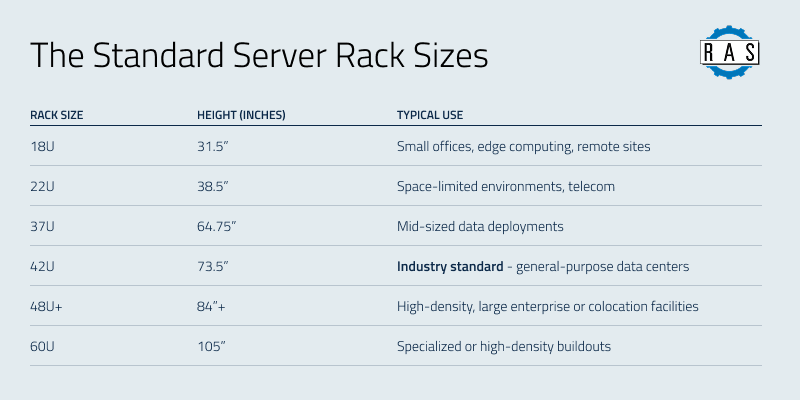
This standardization, when it comes to server rack sizes, matters for a few reasons. Having consistent dimensions ensures easier operation across manufacturers and systems integrators. Let’s say you’re stacking servers from Dell, switches from Cisco, or deploying preassembled cabinets to a hyperscale facility. Standard rack sizing enables faster builds, easier scaling, and simplified planning.
And if you’re manufacturing these enclosures yourself, we’re probably not the first to say that consistency is non-negotiable. That’s why RAS folding machines, such as the Multibend-Center, are used to create precise, repeatable cabinet parts that meet tight tolerances and scale with demand.
Choosing the Right Server Rack Size for Your Business
When considering the servers in your data center, it’s important to factor in the strategy behind your dimensions. Whether you’re running a compact edge data center or a hyperscale environment, here are some factors to consider:
- Available Floor Space
Be sure to first measure both the height clearance and the depth available in your data center. Don’t forget about door clearances or cable routing either, as these will all affect the optimal server rack size.
- Cooling
You’ll also want to have a strategy in place for keeping your servers cool. Taller racks (42U–60U) typically concentrate more equipment in one footprint, which can increase thermal load. Make sure your existing HVAC system can handle the added heat.
- Power Integrations
Higher-density servers in a data center require more power per square foot. You’ll want to ensure your racks can accommodate vertical or horizontal power distribution units (PDUs) without blocking airflow or access.
- Cable Management
Deeper or wider racks allow for better separation of power and data cables, reducing interference and making service easier.
- Data Center Growth
Do you anticipate your business expanding in the future? Keep this in mind when choosing the right server rack size. Many organizations are shifting toward 48U–60U racks to pack more hardware into a smaller footprint.
If you’re uncertain, defaulting to a 42U, 19” wide, 36–48” deep rack will likely fit most equipment and use cases. But for large-scale deployments or fast-growing facilities, starting with 48U or 60U options could future-proof your investment and keep your data center efficient for years to come
At RAS, we offer industry-leading folding machines to help data centers fabricate everything from server racks to full HVAC systems. To learn more about which machines fit your needs, schedule a consultation with our team today.
FAQs
What server rack sizes do I need for a data center?
The right server rack size depends on your equipment count, available floor space, cooling strategy, and growth plans. Many data centers use a standard server rack depth of 42U; however, your final dimensions must meet your unique needs and goals.
What is the normal server rack size in a data center?
The most common server rack size in data centers is 42U, typically 19 inches wide and 36–48 inches deep. This size balances equipment density, airflow, accessibility, and compatibility with most server hardware.
How do you figure out what server rack size you need?
To determine the right server rack size, evaluate your current and future equipment, room clearance, power and cooling capacity, and cable management needs. Planning for growth helps avoid costly reconfiguration later.
Recent Comments